

Can Fiberglass Withstand Freeze Thaw Cycles?
A giant fiberglass sculpture can look flawless on install day and still fail its first hard winter if water has a way into the wrong place. So, can fiberglass withstand freeze thaw cycles? Yes - fiberglass can perform exceptionally well outdoors, but its cold-weather durability depends far more on fabrication details than on the word “fiberglass” alone.
For public art, branded landmarks, themed environments, architectural features, and oversized props, freeze-thaw resistance must be designed into the complete build. That means the laminate, internal structure, joints, finish system, drainage plan, mounting method, and maintenance expectations all need to work together. A visually ambitious form is only successful if it arrives, installs, and stays intact through changing seasons.
Can Fiberglass Withstand Freeze Thaw Cycles Outdoors?
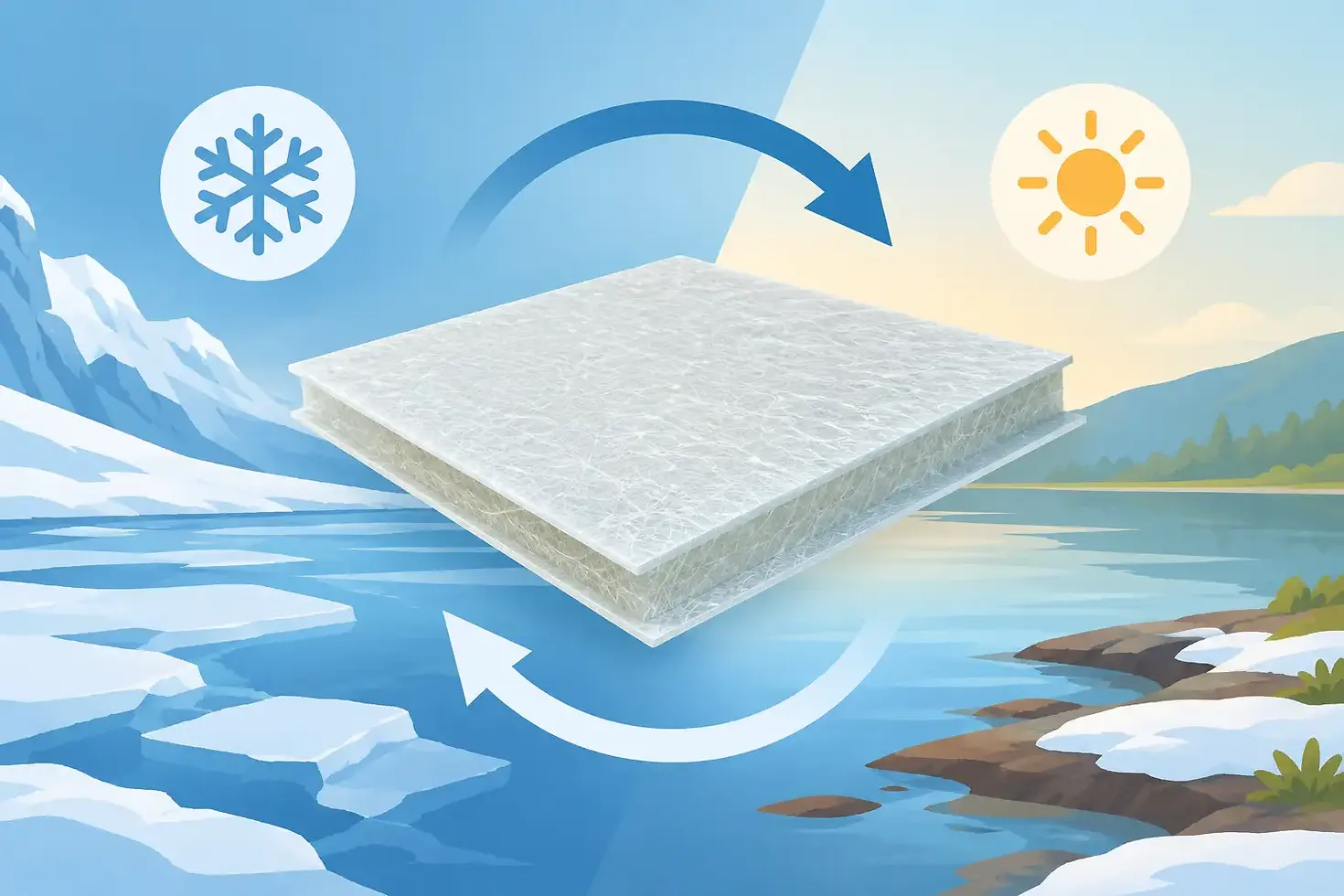
Fiberglass-reinforced plastic, often called FRP, does not absorb water in the same way as porous materials such as concrete, untreated wood, or some stone. That is a major advantage in climates that regularly move above and below freezing. Properly built fiberglass shells can remain stable through repeated winter exposure without cracking simply because the temperature drops.
The risk begins when moisture enters a void, an unsealed seam, a damaged finish, or an improperly detailed connection. Water expands by roughly 9 percent when it freezes. Inside a confined cavity or along a joint, that expansion can push materials apart, compromise a bond line, deform a thin panel, or create a path for still more water. What starts as a hairline opening can become a visible failure after several seasons.
Fiberglass itself is not a single material with a single weather rating. Performance changes based on resin type, glass reinforcement, laminate thickness, core material, gelcoat or paint system, and the quality of the fabrication process. An indoor display piece and a permanent exterior civic installation may both be described as fiberglass, yet they should not be engineered or priced the same way.
What Actually Fails During Freeze-Thaw Exposure
In our experience with large-scale fabrication, the weak points are usually transitions. Broad, well-laminated surfaces often hold up well. Seams, penetrations, hardware locations, sharp edges, low points, and interfaces between dissimilar materials require closer attention.
A seam that is cosmetically filled but not structurally bonded can separate as the assembly moves with temperature changes. A bolt penetrating the shell can introduce water if it lacks proper flashing, sealant, backing, and drainage. A hollow form with no controlled way to shed condensation or rainwater may trap moisture where no one can see it.
Finish failure can also expose a larger issue. Paint checking, blistering, or peeling may result from UV exposure, impact damage, poor surface preparation, or moisture working behind the coating. The finish is not merely decorative on an exterior fabrication. It is part of the weather-management system.
Metal substructures deserve the same level of planning. Steel expands and contracts differently than fiberglass, and untreated steel can corrode if moisture enters the assembly. When steel reinforcement is necessary, it should be protected, isolated where appropriate, and detailed so water does not sit against it. The structural strategy needs to support the shape without creating hidden corrosion or stress points inside the shell.
Material Choices That Improve Cold-Weather Performance
The right resin system matters. General-purpose polyester resin may be acceptable for certain controlled applications, but demanding exterior work may call for higher-performance polyester, vinyl ester, or epoxy systems depending on the project’s exposure, geometry, chemical environment, and budget. The material decision should be based on the real service conditions, not just initial cost.
Laminate design matters just as much. Thickness alone is not a complete answer. A thick but poorly consolidated laminate can contain voids or inconsistent reinforcement. A properly specified layup places reinforcement where loads, attachment points, impact risk, and geometry demand it. Large cantilevered elements, narrow projections, and high-touch public features may need local reinforcement beyond what the visible shell suggests.
Core materials require caution in wet environments. Closed-cell foam can be useful for stiffness and shape development, but the edges and penetrations must be sealed. Some lightweight core materials are unsuitable where prolonged moisture exposure is possible. If water can find its way into a core, freeze-thaw cycling can turn a localized defect into a costly repair.
For outdoor sculptural work, the exterior finish should be selected as a system: surface preparation, primer, compatible topcoat, UV resistance, flexibility, and repairability. A high-performance coating cannot compensate for poor drainage or an underbuilt shell, but it can extend service life when the underlying fabrication is sound.
Design for Water Management, Not Just Water Resistance
The most reliable exterior fiberglass builds do not assume that water will stay out forever. They give water a safe path out.
That means avoiding flat, concealed surfaces that collect rain or snowmelt. It means incorporating slopes, drip edges, weep paths, access points, and sealed-but-serviceable connections. It also means thinking about the installation orientation. A form that drains properly in a shop can become a water trap once it is tilted, mounted, or integrated with a site-built base.
Large fabrications often include internal ribs, frames, mounting plates, electrical conduits, lighting components, or access doors. Each addition changes the water-management plan. Exterior access panels need gaskets and proper overlap. Electrical penetrations need weather-rated fittings. Low areas need drainage that does not compromise structural integrity or create an obvious visual interruption.
Transport and installation can affect freeze-thaw performance, too. A sculpture may be built in multiple sections for shipping, then joined on site. Those field seams need the same discipline as shop-made seams, including surface preparation, alignment, structural bonding where required, finish restoration, and cure conditions appropriate for the weather. A rushed field repair in cold or wet conditions is not equivalent to a controlled fabrication process.
Structural Movement Is Part of the Engineering
Cold weather does not only bring freezing water. It brings thermal movement, snow loads, wind, ice, and occasional impact from maintenance equipment or public use. Fiberglass has a different coefficient of thermal expansion than steel, aluminum, concrete, and wood. On a large piece, those differences can add up.
A successful design allows components to move where they need to move while keeping the exterior surface secure. Rigidly locking a fiberglass shell to a steel frame at every location can concentrate stress as temperatures shift. Depending on the structure, the better solution may use engineered attachment zones, slotted connections, flexible sealants, or isolated mounting details.
This is especially relevant for installations attached to existing buildings, foundations, or landscapes. The site structure may move independently due to settlement, temperature, or seasonal moisture changes. Early coordination with structural engineering and site teams prevents a beautiful fabrication from becoming the point where those movements collide.
When Fiberglass Is the Right Choice
Fiberglass is often an excellent material for outdoor forms that need complex geometry, a smooth finished surface, manageable weight, and repeatable fabrication. It is particularly effective for sculptural shells, dimensional logos, animal figures, themed facades, decorative architectural elements, and large objects that must be moved through constrained sites.
It is not always the best answer. A high-abuse public installation may benefit from a heavier structural skin, metal armature, or a different material at impact-prone areas. A piece exposed to constant standing water, marine conditions, or extreme temperature swings may require a more specialized resin and coating specification. If the project must tolerate vehicle strikes, climbing, or heavy snow accumulation, structural engineering may drive the material choice more than appearance does.
The practical question is not whether fiberglass is universally weatherproof. The question is whether the proposed fiberglass system is engineered for the actual location, public interaction level, maintenance access, and expected service life.
A Better Brief for Exterior Fiberglass Projects
Project teams can reduce risk by defining environmental conditions early. Share the installation location, whether the piece is permanent or temporary, expected lifespan, mounting surface, public accessibility, local wind and snow considerations, lighting needs, shipping constraints, and any maintenance limitations. A fabrication partner can make better recommendations when the full operating environment is known.
For a winter-exposed installation, ask how seams are constructed, how cavities drain, what reinforcement supports mounting points, how dissimilar materials are isolated, and what finish system is specified. Also ask what happens after installation: Can the piece be inspected? Can damaged areas be repaired without removing the full structure? Is there a realistic plan for seasonal cleaning and touch-up?
At We Build the Amazing, those questions are part of turning an ambitious concept into a buildable object. The goal is not simply to produce an impressive form in the shop. It is to deliver a finished installation that can handle transport, weather, public exposure, and the practical realities of the site.
Freeze-thaw durability is rarely won by one premium material or one heavy coat of paint. It is earned through disciplined detailing: keep water from entering, give it a route out when it does, accommodate movement, protect vulnerable transitions, and build the structure for the conditions it will actually face. That is how fiberglass remains an effective material long after the first winter arrives.


Comments